Previous: Looking closer at the new Space Utilization formula
In order to assess the effectiveness of the Space Utilization formula to reflect the Real Use of Haugan Elementary school, I need to understand how its rooms are actually being used. Luckily, the Haugan LSC (Local School Council) has already mapped their school’s Real Use using the template that CPS A2A developed back in 2012-2013. I can use their actual current data.
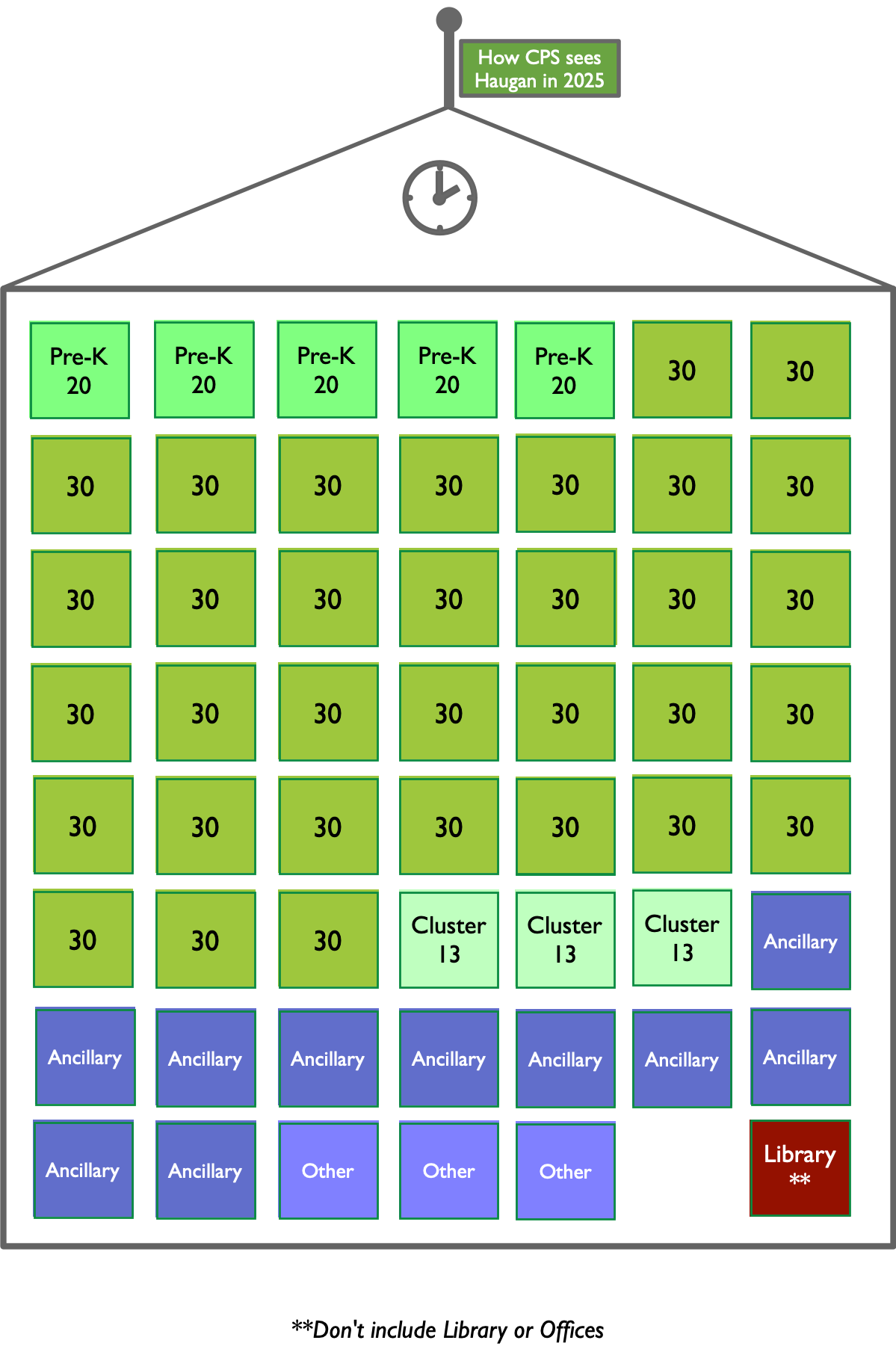
So let’s look at how CPS sees the Space Utilization of Haugan Elementary with the new formula. And then let’s compare that to the LSC’s Real Use of the Haugan Elementary School spaces.
This is how CPS would like to see Haugan Elementary utilized according to the new Space Utilization formula (click to enlarge these graphics):
This is how Haugan Elementary is currently utilized (per the Haugan LSC):
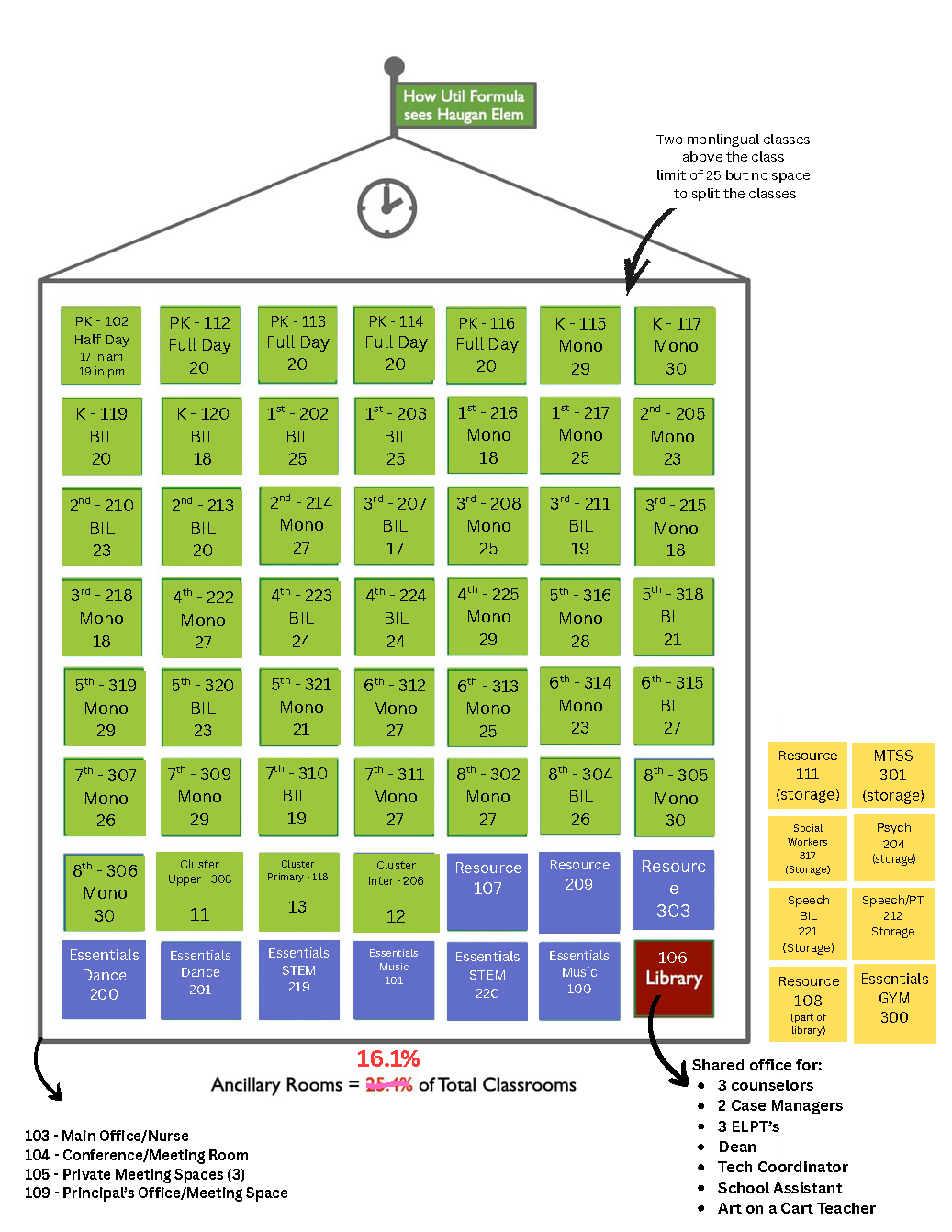
These scenarios look so different! What is happening here?!
In this previous post, I described the unique challenge that Neighborhood Schools face.
Haugan Elementary is a Neighborhood School, which is a very particular type of school in the CPS school portfolio. Unlike schools which can control their admissions per grade and/or performance of student (such as Selective Enrollment, Charter, Magnet or Special Education schools) and cap enrollment when a classroom is “full”, Neighborhood Schools are the workhorse schools of the District. They take the students in their neighborhood who show up…all year round…and do not have restrictions on timing for admissions or the ability to turn away a student because a certain grade or classroom is at the maximum limit.
If this means that the school planned for two first-grade classrooms of 28 students each (56 total), but 72 first-graders show up to the school that year? The staff has to figure out how to accommodate those students. Either by creating two classrooms of 36 students each, or three classrooms of 24 students each.
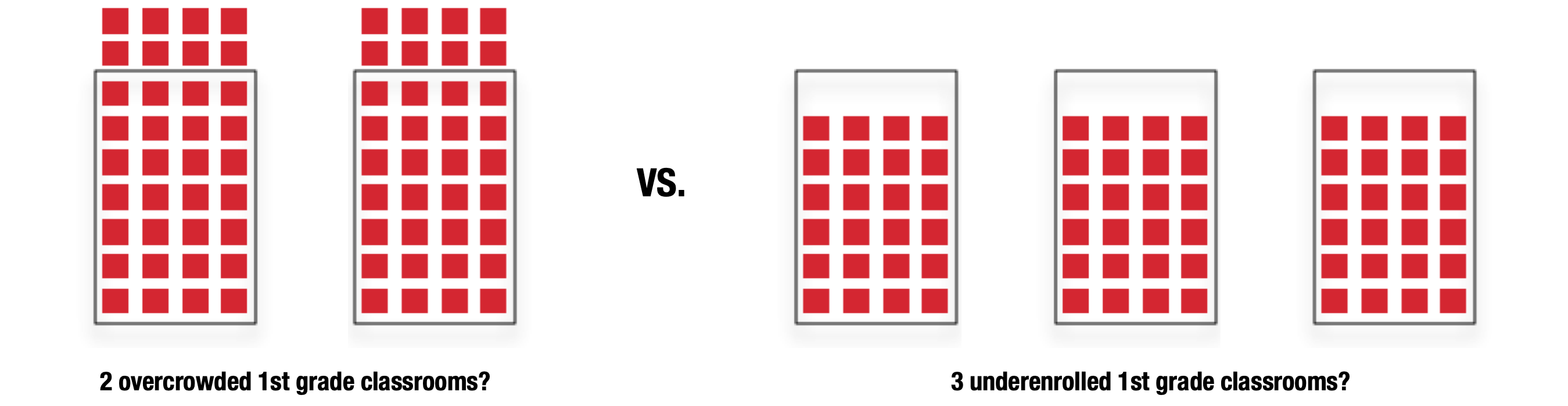
This is the situation that Haugan faces. These grade enrollments don’t divide neatly by established classroom maximums, and the high percentage of students receiving ELL services makes it more complicated. We cannot calculate the IEP attributed per room (this data is not available to us) so we do not know from these numbers which of these are diverse learner inclusive classrooms which would also figure into classroom placement. According to Haugan’s LSC, here is what they have in the K-8 grades:
| Grade | # of Students in Grade (# receiving ELL Services) | Classroom Maximum |
| Kindergarten | 97 (63) | 25 maximum per class |
| First Grade | 93 (50) | 28 maximum per class |
| Second Grade | 93 (43) | 28 maximum per class |
| Third Grade | 97 (36) | 28 maximum per class |
| Fourth Grade | 104 (48) | 30 maximum per class |
| Fifth Grade | 122 (44) | 30 maximum per class |
| Six Grade | 102 (27) | 30 maximum per class |
| Seventh Grade | 101 (19) | 30 maximum per class |
| Eighth Grade | 113 (26) | 30 maximum per class |
This is truly the “perfect storm” of impossible choices for the Haugan staff. Choices such as:
- Do they consolidate and encourage situations such as setting up three seventh-grade classes of 33 to 34 students each, and risk not adequately supporting the ELL and IEP learners, but gain an ancillary classroom? And/or kindergarten classrooms of 32-33 students? And/or 8th grade classrooms of 37-38 students?
- Do they subtract even more ancillary classrooms to accommodate special resource space needs, but end up with students losing out on important ancillary offerings (like the arts or STEM)? Do they deliver those on a cart, but deal with the emotional/behavior management fallout of students who will have the movement restricted to one classroom most of the day?
- Do they risk non-compliance by ignoring or reducing the required services and minutes for IEP and ELL support?
- And so on.
The CPS Administration in 2012-2013 had an answer for this. They suggested that 20% over the classroom maximum was completely efficient, to which I responded “why have maximums if you are not going to adhere to them?“
So what is the final answer then? What can we do to adhere to agreed upon (and contractually mandated) classroom maximums PLUS provide adequate/required services to students PLUS accommodate the flexibility that open admissions Neighborhood Schools require PLUS make better decisions about school utilization to prevent overcrowding?
Next: Neighborhood Schools: Space to Flex Needed
Previous: Looking closer at the new Space Utilization formula
 Apples 2 Apples in Chicago Public Schools
Pingback: Looking closer at the new Space Utilization formula | Apples 2 Apples in Chicago Public Schools
Pingback: Neighborhood Schools: Space to Flex Needed | Apples 2 Apples in Chicago Public Schools