
Previous: Haugan Elementary: A Case of Space Utilization
Space Utilization or, how many students can (or should) a school hold? Why is it an important (and sometimes controversial) number?
It’s important because the Ideal Space Utilization of a school has an effect on so many other decisions about the school. Including, but not limited to:
- Class size decisions which can affect the quality of education in the classroom.
- School-specific budget decisions related to staffing and resources.
- School facility decisions related to improvements and/or expansions.
- District-level decisions related to attendance boundaries, or whether to close/open schools.
These are not unimportant decisions. Some of them can have long lasting effects on a student’s educational outcomes and a neighborhood’s quality of resources outcomes. Like the school closings of 2013.

The good news is that CPS has decided to improve the Space Utilization Formula in some ways since 2013. However, they are still using a number 10% higher than the class size maximum as “Efficient”, which continues to skew the numbers and to cause problems. Let me show you how these formula changes apply to a school like Haugan Elementary.
First, let’s look at the new Space Utilization formula and the new average general classroom number based on new class size maximums. We’re going to go step-by-step so parents can follow along and calculate the numbers for their own schools (Remember, this is for elementary schools, I can do the calculation for high schools later if its needed.)
Where did we get the classroom data?
It is harder to find the current classroom data on CPS.edu. I did manage to locate the current CPS Space Utilization data using their new formula. You can find that data here.
Currently, the number of Total Classrooms for Haugan is listed as 54 classrooms. And the new formula is more complicated than the old formula. So let’s unpack it.
This is the initial information about Haugan from the spreadsheet that CPS posted.

My goal here is to figure out how CPS arrived at 1,230 as the Ideal Capacity for Haugan.
First, CPS will deduct any modular or leased classrooms from the Total Classrooms listed for Haugan. But there aren’t any. So the Total Classrooms (54) remains the same.
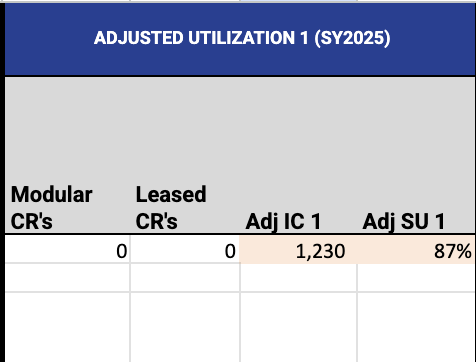
Next, CPS will deduct any Pre-K, Cluster, “small” classrooms or “other” classrooms from the Total Classrooms listed. They do not define or clarify which classrooms would be classified as “other”. (I could guess that these might be rooms that have features which are not easily adapted, such as a science lab with specific fixtures. But that is only a guess at this point.)

The next step is not made explicit on the Space Utilization report. So I had to reverse engineer it.
CPS uses the “Total CR’s Less Cluster, Pre-K, Other & Small” to calculate K-8 classrooms vs. Ancillary classrooms.
43 Total CR’s * 77% = 33 K-8 classrooms
43 Total CR’s – 33 K-8 Classrooms = 10 Ancillary classrooms
So, the distribution of classroom types at Haugan now looks like this according to CPS:
| # of K-8 Classrooms | 33 |
| # of Pre-K Classrooms | 5 |
| # of Cluster Classrooms | 3 |
| # of “Other” Classrooms | 3 |
| # of Ancillary Classrooms | 10 |
| TOTAL: | 54 |
And if you look at the “average classroom size” number that CPS is applying to each room type, it seems to be this:
| # of K-8 Classrooms | 33 | 33 * 30 students = 990 |
| # of Pre-K Classrooms | 5 | 5 * 20 students = 100 |
| # of Cluster Classrooms | 3 | 3 * 13 students = 39 |
| # of “Other” Classrooms | 3 | 0 |
| # of Ancillary Classrooms | 10 | 0 |
Based upon the CPS Space Utilization Report, CPS has only used the K-8 Classrooms and enrolled K-8 Students to determine utilization.
They deducted the students enrolled in Pre-K and Cluster classrooms from the Total Number of Enrolled students to Adjust the 20th Day Enrollment (1,074 enrolled students – 156 Pre-K/Cluster students = 918 K-8 Students):

And that is how CPS has decided that Haugan is at 93% Utilization (which is categorized as efficient).
At first glance, I’m pleased. The Utilization Formula is no longer penalizing schools with Pre-Kindergarten and/or Cluster and/or Small Classrooms. That is a big improvement. It is getting much closer to the Real Use of CPS Elementary Schools.
But there are still some questions and issues I have with the formula, and those have to do with the assumptions embedded in this current version of the formula.
 Apples 2 Apples in Chicago Public Schools
Pingback: Neighborhood Schools: Space to Flex Needed | Apples 2 Apples in Chicago Public Schools