Recently, I was asked about CPS’ School Utilization of a specific school in the Albany Park neighborhood of Chicago. I’ll get to that in a minure. Or you can see where the Chicago Tribune wrote about that school here.
It has been a few 10 years since I’ve looked at the Space Utilization formula and data for Chicago Public Schools. What has changed?

Well. Some things have changed. Back in 2012-2013, I recommended that CPS (at minimum) change their Space Utilization formula to accommodate the legal limitations on students kept in Pre-Kindergarten and Self-Contained classrooms. And (more importantly in my opinion) that they change the “ideal” utilization of the school to more accurately reflect the maximum class sizes per grade, and use the maximum as the top of the “Efficient” range for each school.
Let’s catch up. In the intervening years:
- The maximum size of kindergarten classes was dropped to 25 students per room (versus the previous 28 per room).
- The maximum size of classes for grades 1 through 3 was kept the same (28 per room).
- The maximum size of classes for grades 4 through 8 was dropped to 30 per room (versus the previous 31 per room).
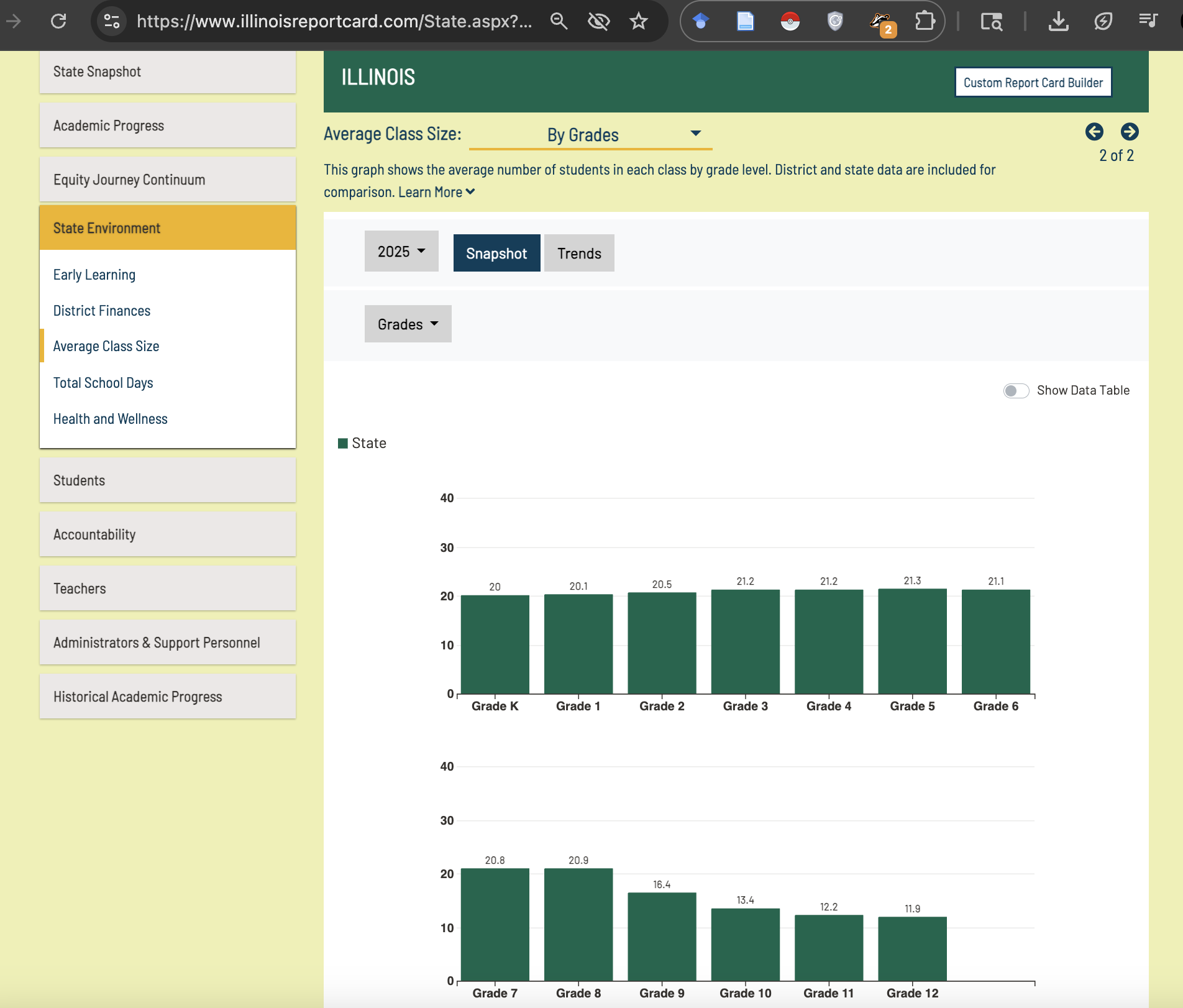
This is a (small) step in the right direction at least, but far above the average classroom sizes for the State of Illinois as a whole, where class sizes average between 20 and 21.3 students per classroom for grades K through 8.
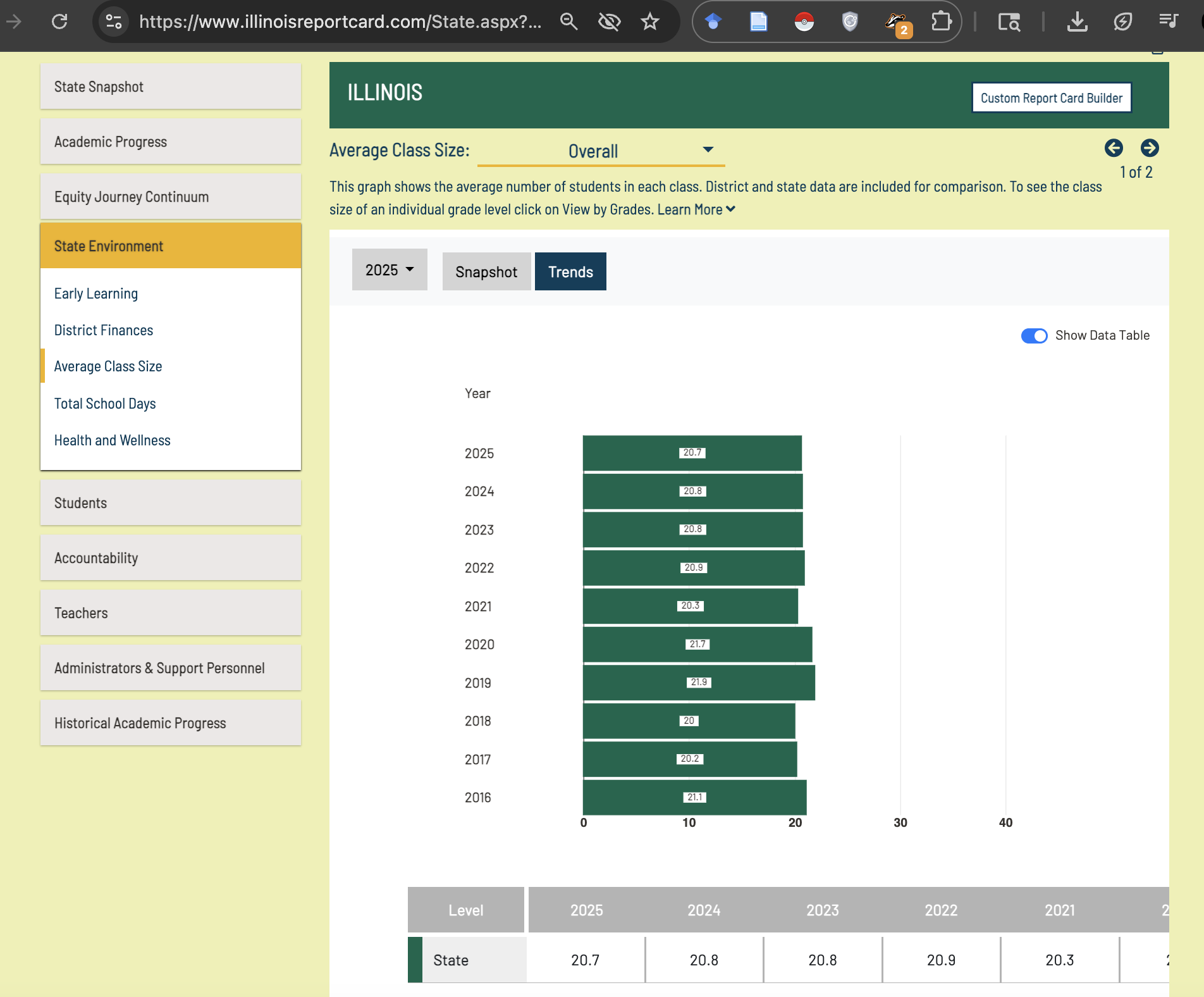
This trend for the State’s average class sizes across all grades has remained relatively consistent for the past 10 years (possibly earlier, I’d have to go back to my data archive to confirm.)
Also in the intervening years, we’ve seen:
- An acknowledgement that schools with Pre-Kindergarten and Self-Contained classrooms should not be penalized by the Space Utilization formula (finally!) I’ll say more about this shortly.
- A (small) concession in the Space Utilization formula, where the top of the range for the “Efficient” rating is only 110% of the maximum (instead of 120% of the maximum). “Underutilization” is considered less than 70% of the “Ideal.” Still need more work here.
- Promises of more professional support staff for high-needs schools (implied that high needs schools have more IEP and other special education needs; more needs with a higher percentage of ELL students; more needs with a higher percentage of low-income and homeless students.) I believe that students getting their needs met so as to reduce barriers to learning is very commendable.
If these extra services supported by staff were provided, this should create adjustments to the space utilization formula as well, correct? After all, these staff members need to deliver their services somewhere within the school and I would imagine that the intent would not be to deliver those services in a hallway.
Not so fast…there is a lots to unpack. Which leads us to the specific school I was asked about…Haugan Elementary School.
 Apples 2 Apples in Chicago Public Schools
Pingback: Looking closer at the new Space Utilization formula | Apples 2 Apples in Chicago Public Schools
Pingback: Neighborhood Schools: Space to Flex Needed | Apples 2 Apples in Chicago Public Schools